
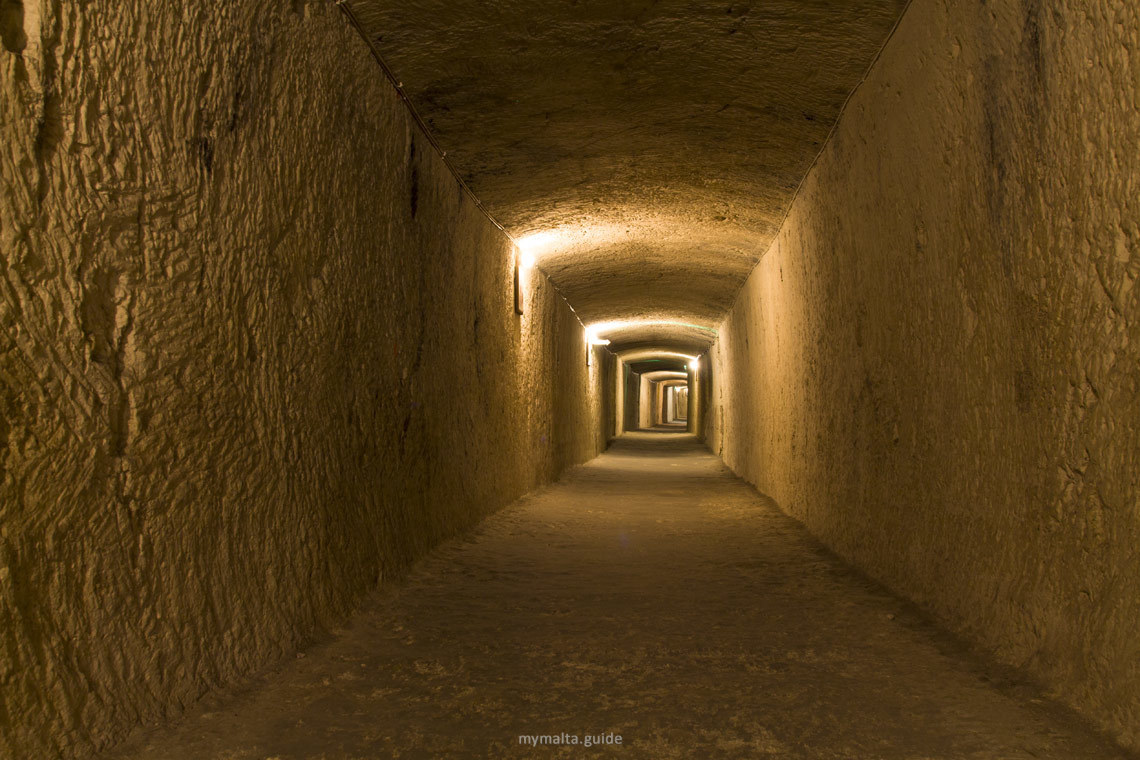

A long corridor cut into soft rock, lit by a few lamps, is not what most people picture when they think of a Maltese holiday. At Mellieħa it is the reason to come, and a short walk inside tells you more about the war years than most displays above ground.
Dug by hand
The Mellieħa shelter is one of the largest of its kind in Malta, with more than 500 metres of passages dug entirely by hand. Malta’s limestone is soft enough to cut with tools, and whole communities did exactly that when the bombing began. This complex is a record of what organised effort could achieve with picks and shovels.
The scale is easy to underestimate from the entrance. Inside, the tunnels run on and branch, and the length starts to register.
What the shelter contains
The design includes long corridors with anti-blast chambers, which reduced the force of a nearby explosion. There are private rooms where whole families could live, a maternity section, and a guarded room reserved for protecting national treasures. These details show that the shelter was meant for long stays, not a few hours’ cover.
It served the people of Mellieħa and refugees from elsewhere on the island. The idea of families sleeping, eating and giving birth underground is hard to picture until you stand in one of the rooms and see its size.
Inside the walk
The visit is a walk, not a show. You move through the corridors at your own pace, with information along the way. The air is cool and slightly damp, the ceilings are low in places, and the floor changes level more than once.
That atmosphere is the point. After a few minutes it becomes clear why people called these places home during the siege and why the memory of them stays strong in the town.
Mellieħa above ground
Mellieħa is a hill town at the northern end of Malta, and its streets run steeply to the sea. Our Lady of the Grotto Street, where the shelter sits, is close to the centre, so you can reach it on foot after parking or arriving by bus.
The town has several sights close together, which makes it easy to build a half day. Mellieħa Bay, the longest sandy beach on the island, is a short ride downhill and suits the second half of the day. Selmun Palace stands on the ridge nearby, a stately building that shows up on many northern walks.
Why shelters like this exist
Air raids on Malta were frequent and heavy in the early 1940s, and civilians needed safe cover. Public shelters were dug in the soft limestone beneath towns and villages, often by the residents, and families moved in for long periods. Mellieħa’s complex is one of the larger survivors, and it shows how much was done by a small community.
Children were born in the maternity section, and local people used rooms in the same way as homes, with beds, cooking and storage. Those facts make the empty rooms easier to read. When you reach the guarded chamber for national treasures, notice how secure it is compared with the rest, a reminder that protection extended to cultural objects as well as people.
The shelter also fits with other wartime sites in Malta, including the Lascaris War Rooms in Valletta and the war museum at Fort St Elmo, if you are tracing the period across the island.
Practical advice
Plan on about 45 minutes. Bring a thin layer even in summer, since the air underground feels much colder than the street, and wear shoes with decent grip. Wheelchair users and anyone with trouble on steps should ask about access first, because the shelter is underground and the floors are uneven.
Going in the morning is a good habit in warm months. The shelter is cool, and you can spend the afternoon on the beach without worrying about the time. In winter the order reverses: see the shelter at midday, when the town is bright.
Making a day of the north
A day built around Mellieħa works with a few simple steps. Start with the shelter, climb to the parish church square for a coffee, and finish at the bay. Add Selmun if you have a car and prefer something quiet. Check the current opening times before going, since the shelter keeps its own schedule and is closed on Sundays.


