
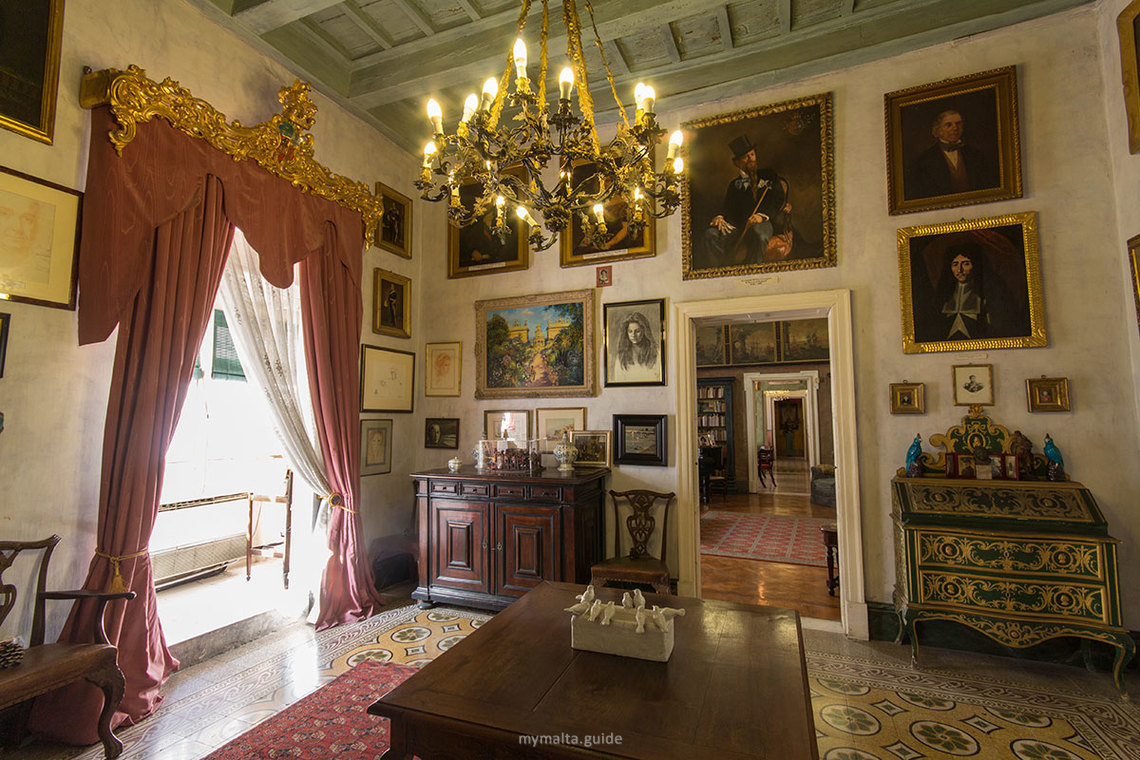
Casa Rocca Piccola announces itself with very little. A discreet door on Republic Street, a few steps and a guide in the entrance hall, and suddenly you are inside a palace that people still call home. That is the appeal: it is a museum of aristocratic life run by the people who live it.
A palace with a garden
The house was built in 1580 for Don Pietro la Rocca, an admiral of the Order of St John who came from Italy. In its day it was built to match the prestige of palaces in Venice and Paris, and it stood out in Valletta because it had a garden. Other houses in the new city were not allowed one. The de Piro family has lived here through the centuries, and the house reflects some four hundred years of noble life on the island.
Rooms and layout
More than fifty rooms are spread through the house, and most are open to visitors. The arrangement follows a familiar pattern for palaces of the period: stables and kitchen on the ground floor, and long enfilades of rooms on the first floor. The family opens new rooms from time to time, and a gallery has been created to show the work of local painters.
Among the rooms to look out for are the Summer Dining Room, which overlooks the garden, the Library and the Chapel. The numerous drawing rooms are worth time too, because they show how the family entertained.
Collections
The collections are among the richest private holdings in Malta. Furniture includes a chess set thought to be among the oldest examples of locally made furniture from the time of the Knights. A group of traditional Maltese Tal-Lira clocks sits among the paintings by European and Maltese artists, where the works of Mattia Preti stand out. Silver includes a collection of surgical instruments used in the Knights’ medical practice.
The house also holds the largest private collection of antique costumes, both formal and everyday clothes from the 18th to the 20th centuries, and the largest private lace collection. The annual Malta Lace Competition takes place on the premises.
Changes over time
The building has changed several times. In the 18th century it was divided into two smaller houses, and in 1918 and again before the Second World War air raid shelters were dug beneath it. These underground tunnels have become a point of interest for visitors, and walking through them is a vivid contrast to the elegant rooms above.
In the 1990s the current owner, Nicholas de Piro d’Amico Inguanez, began restoration work, and the house first opened to visitors. A further restoration in 2000 reunited the section that had been separated. The palace today is kept in very good condition.
What the tour feels like
Because the house is lived in, the guide talks about the family as well as the furniture, and details such as portraits, family anecdotes and the odd modern object give the visit a human scale you do not get in a state museum. The tour moves steadily, but questions are welcome, and guides tend to know which stories visitors enjoy most. Expect the shelters at the end to feel quite different from the elegant rooms: cooler, plainer and quiet.
Practical points
Visits are guided, so arrive on time and expect to stay with the group. Opening days are limited, and the house is closed on Sundays and public holidays, so confirm times before you plan. Wear comfortable shoes; the tour involves stairs and uneven floors.
Photography rules can vary by room, so ask the guide. The shelters are underground and can feel cool and enclosed. If the house is open for a special event, parts may be unavailable.
Nearby
Republic Street, the spine of Valletta, offers everything else within a short walk. The Malta Postal Museum, Manoel Theatre and Palace Armoury are all close, and the Grandmaster’s Palace is a few minutes away. A morning at the house followed by lunch on one of the side streets is an easy plan.
Treat the house as a half-hour break from the heat of the street, then spend a quiet hour inside the rooms where the same family has lived for generations. Book the first tour of the day to avoid crowds.


