
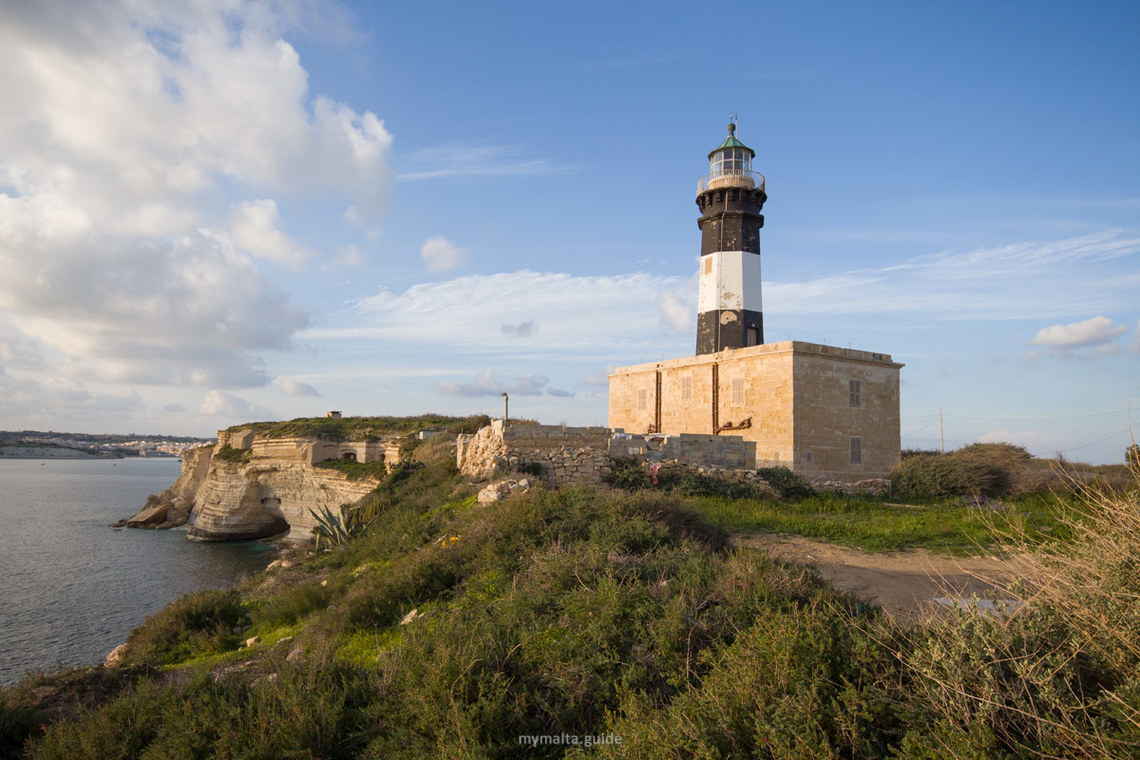
A red light glowing over olive oil lamps sounds like a story from a different century, and it is. The first version of the Delimara light worked that way, and the building that housed it still stands on the cliff edge at the south-eastern tip of Malta.
A beacon for the south
Delimara Lighthouse stands on the Delimara cliff edge near Marsaxlokk and acted for many years as a beacon for Maltese shipping. Apart from its location, its most distinctive feature is the Fresnel lens, which makes it the only lighthouse in Malta fitted with one.
The name Delimara may be a corruption of the term “dejr l-imnara”, which literally means “the house of the lantern”. Whether or not that origin is exact, the name suits the building.
The tower and its design
The lighthouse consists of an octagonal tower about 22 metres high with a two-storey house beneath it. It is considered a landmark of British architecture on the island. The proportions are solid rather than ornamental, and the setting, high above open water, gives it presence.
From the road and the cliff paths nearby you can see the whole structure against the sky, and at sunset the stone and stripes take on warm colours.
How the light worked
The history of the lighthouse starts in 1850, during British rule, when Governor Sir Richard More O’Ferrall commissioned the building of another lighthouse at Delimara. The initial lighting system produced a constant red light, using lamps powered by olive oil. In 1896 this was replaced by a rotating optic system, which used a rotating table coupled with a Fresnel lens to produce an alternating red and white flash every thirty seconds.
The apparatus was powered by a weight that slowly descended from the lantern room and drove a clockwork mechanism, turning the table at a set rotation. Later it was lit using lamps powered by paraffin, stored in a copper tank with ornate brass fittings. Its arc of visibility ranged from 19 to 295 degrees, with a radius of up to 15 miles.
Stripes, shutdown and revival
In 1950 the lighthouse changed its look, because mariners could not easily locate it during the day. It was painted in black and white stripes so that it could be recognised from a distance. The light stopped functioning in 1985 and the building was decommissioned soon after, standing abandoned for decades.
In 2014 a major restoration repaired damage to the walls, roof, tower and the lantern mechanism with the Fresnel lens. After the work, the keeper’s accommodation was transformed into two apartments available to tourists. If you want to sleep beside a lighthouse, check the current booking arrangements.
Planning the visit
Treat the lighthouse as part of a wider day on the south-eastern side of Malta. Marsaxlokk, with its fishing harbour, is the usual base for lunch, and the peninsula beyond includes the rock bay of St Peter’s Pool. Għar Dalam Cave, an important prehistoric site, is a short drive inland.
The roads on the peninsula can be narrow and rough in places, and there is little shade, so bring water, a hat and a camera. Late afternoon gives the best light on the tower and the coast. If you plan to enter any part of the site, check current access first, since arrangements can change.
Looking at the tower
Stand back from the building and take in the proportions. The octagonal tower rises from the two-storey house at its base, and the stripes make the geometry easy to read. On clear days the sea below shades from turquoise at the rocks to deep blue farther out.
If you have time to walk the surrounding cliff paths, keep a good distance from the edge. The ground is rocky, and the cliffs drop away suddenly in places. Do not cross fences or enter areas that are closed off.
Combining it with the peninsula
Delimara is a quiet part of the island, with open land, small bays and few buildings. A drive along the peninsula is rewarding, particularly in spring when the countryside is green. In summer the land is dry and bright, and the wind can be strong near the cliffs.
Marsaxlokk is the best place to eat. Its harbour is full of traditional fishing boats, and its restaurants specialise in fish. A lunch there, followed by an afternoon at the lighthouse and a swim at St Peter’s Pool if conditions are calm, makes a satisfying day in the south-east.


